Leadership & Delivery
Welcome to the Era of Enterprise AI Software Engineering-EASE Framework
The foundation for something I’ve been refining through real enterprise projects and architecture engagements. I call it the EASE Framework (Enterprise AI Software Engineering). In this article, I share my perspective on: • Why enterprise software is still an investment, even when AI writes a significant portion of the code • A practical framework for planning and delivering AI-assisted enterprise applications • The science behind estimating software projects in the AI era
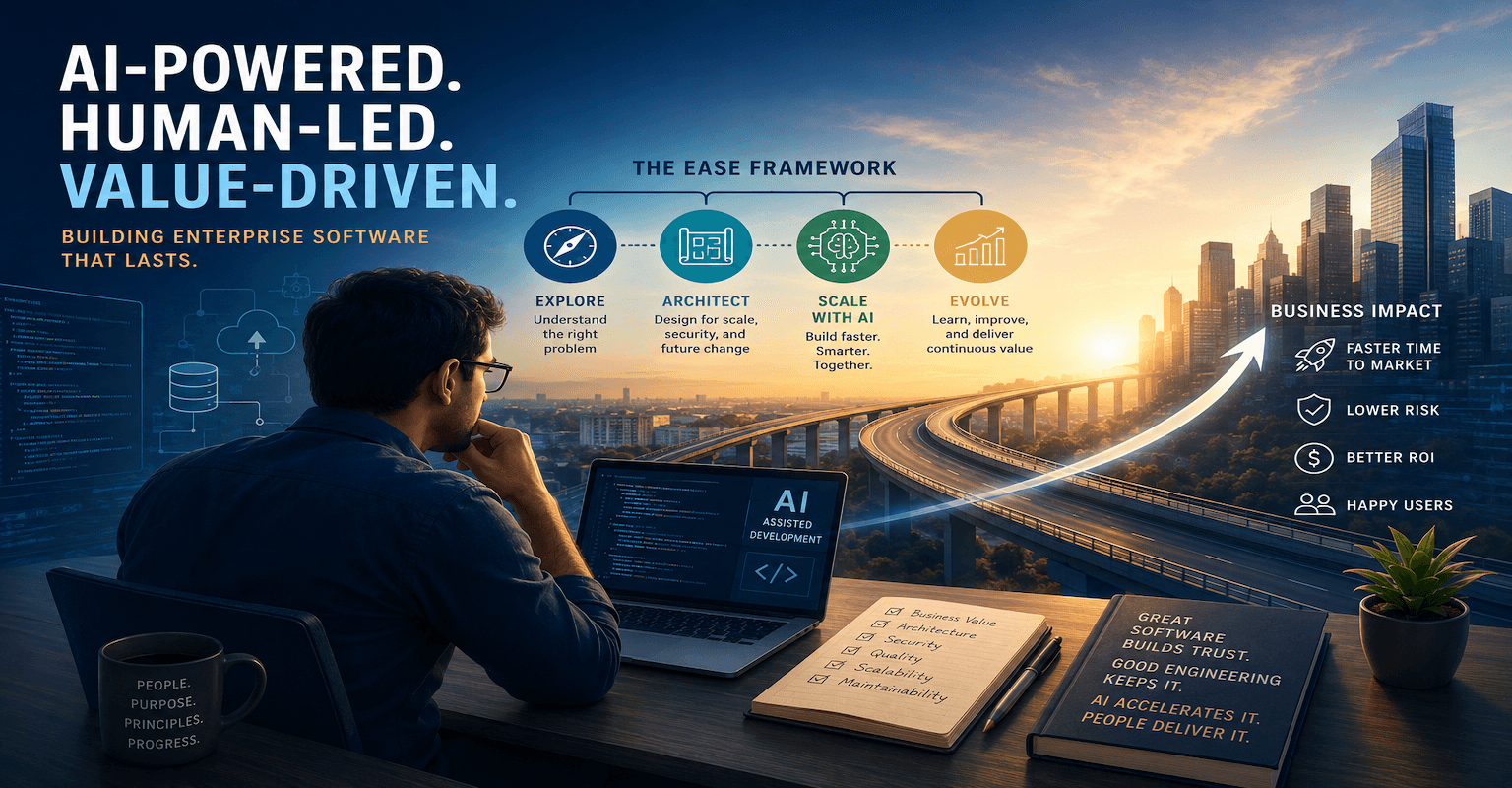
“If AI can write the code, why are enterprise software projects still so expensive?”
I’ve lost count of how many times I’ve been asked that question over the past year. Sometimes it’s a CEO trying to understand why a project still needs experienced engineers. Sometimes it’s a customer who has just watched an AI build a working application in twenty minutes. Sometimes it’s another architect wondering how AI changes the way we estimate projects. The question is always different. The assumption behind it is always the same.
"If AI writes most of the code, software should become dramatically cheaper."
At first glance, that sounds perfectly reasonable. After all, today’s AI tools can generate APIs, build user interfaces, write SQL queries, create unit tests, document code, generate infrastructure templates, and even scaffold complete applications in minutes. If that’s true, shouldn’t development costs fall by seventy or eighty percent?
My answer is usually simple - "No."
Not because AI isn’t capable but because writing code has never been the biggest challenge in enterprise software engineering.
Twenty Years Changed My Perspective
I’ve spent most of my career designing and delivering enterprise software. Some projects succeeded beyond expectations. A few taught painful lessons. Every one of them reinforced the same idea.
"Technology is rarely what makes enterprise software difficult. but
- People do.
- Business processes do.
- Changing priorities do.
- Legacy systems do.
- Security requirements do."
The more complex the organization becomes, the less time engineers actually spend writing code. That surprises many people.
When I first started my career, I believed software engineering was mostly about writing good code.
Today I think very differently. Code is important. It just isn’t where most enterprise risk lives.
A Project I’ll Never Forget
Several years ago, I was leading the delivery of a large enterprise platform. The engineering team was excellent. Sprint after sprint, features were delivered on time. Code quality was solid. Automated testing looked healthy. From the outside, everything appeared to be moving exactly as planned.
Then something interesting happened. The business started learning from the software. Sales leaders wanted different incentive rules. Finance requested additional reporting. Security teams introduced new access policies.Another application changed its integration interface. Operations identified workflow gaps nobody had noticed during requirements gathering.
Almost overnight, months of planning had to be revisited. The developers weren’t creating the delay. They were responding to a business that was still discovering what it needed. That project changed how I think about software forever.
It also explains why AI won’t magically reduce enterprise software costs by eighty percent.
AI Didn’t Replace Engineering
It Changed Where Engineering Happens.
Last year I started experimenting with AI much more aggressively. Not as a chatbot. Not as a search engine. As an engineering partner. I wanted to understand where AI genuinely creates value and where experienced engineers still make the biggest difference.
The results surprised me.
- AI could generate code faster than I expected. Sometimes dramatically faster.
- It could build APIs.
- Generate data models.
- Create dashboards.
- Refactor legacy code.
- Produce documentation that would’ve taken hours to write manually.
But every time the generated code reached a certain level of maturity, the same questions appeared.
- Does this architecture scale?
- Is the security model correct?
- Will this design survive future business changes?
- Are we introducing technical debt?
- Can operations support this application three years from now?
None of those answers came from AI. They came from experience.
That’s when I realized something important - AI isn’t reducing engineering effort. It’s redistributing engineering effort.
And that’s a completely different conversation.
That Realization Led to the EASE Framework
After working on multiple AI-assisted initiatives, I started noticing a pattern. The successful projects weren’t necessarily using the most advanced AI models. They weren’t using the most expensive development tools either. What they shared was something much simpler.
- They approached AI with discipline.
- Architecture came before automation.
- Business understanding came before prompting.
- Engineering judgment remained central to every important decision.
Over time, those observations evolved into what I now call the EASE Framework (Enterprise AI Software Engineering)
I didn’t create it in a workshop. I didn’t build it by reading research papers. It evolved naturally from years of enterprise delivery, project estimation, architecture reviews, and more recently, from learning where AI genuinely helps and where it doesn’t.
The EASE Framework isn’t another project methodology. It isn’t trying to replace Agile or Scrum.
It’s a practical way of thinking about enterprise software in a world where AI has become part of the engineering team. Because that’s how I see it. Not as a replacement for developers. As another engineer sitting beside us. An incredibly fast one. One that never gets tired. One that sometimes produces brilliant ideas. One that occasionally produces terrible ones with complete confidence. Like every junior engineer, AI still needs review, guidance, and context.
The teams that understand this are already moving faster than everyone else. Not because they’re generating more code but because they’re spending more time solving business problems.
The Biggest Mistake I See Leaders Making
One misconception keeps surfacing in executive conversations. People measure AI by asking a single question.
“How many developers can we replace?”
I think that’s the wrong question. The better question is this.
How much more value can the same engineering team deliver?
Those are very different conversations.
- One focuses on reducing people.
- The other focuses on increasing outcomes.
History has shown us something interesting. Spreadsheets didn’t eliminate accountants. Computer-aided design didn’t eliminate architects. Cloud computing didn’t eliminate infrastructure engineers. Each technology removed repetitive work and elevated the importance of human judgment.
I believe AI is following exactly the same path. In fact, I’ll make a prediction.
I think demand for experienced solution architects and enterprise architects will increase over the next decade. That sounds counterintuitive. But the reason is simple.
As writing code becomes easier, making good architectural decisions becomes far more valuable.
Anyone can generate code. Very few people can decide what should be built in the first place.
That, in my opinion, is where the future of software engineering is heading.
The EASE Framework in Practice
The EASE Framework isn’t another software delivery methodology. It’s not trying to replace Agile, Scrum, Kanban, or any other project management approach.
Think of it as a decision framework that helps engineering teams answer a simple question throughout the life of a project.
“Where should humans lead, and where should AI accelerate?”
That’s an important distinction.
Many organizations are trying to fit AI into existing delivery processes. I think they should be redesigning their engineering processes around AI instead. Not because AI changes everything. Because it changes enough.
Over the last year, I’ve found that successful enterprise projects consistently move through four simple stages.
- Explore.
- Architect.
- Scale with AI.
- Evolve.
Together, they form the EASE Framework.
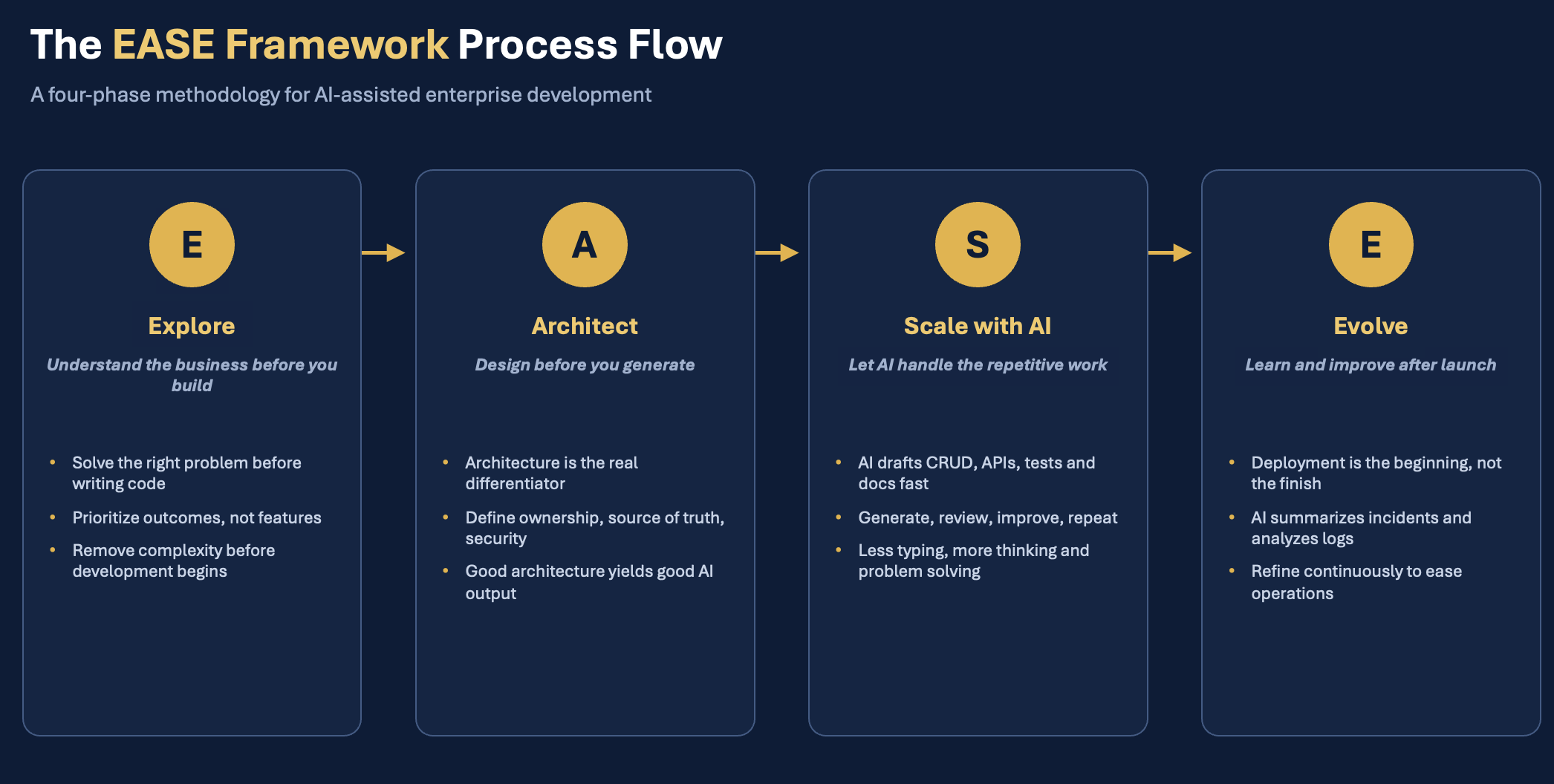
1. E - Explore
Understand the Business Before You Build Anything
This is probably the least glamorous phase. It’s also the most valuable.
I’ve reviewed project estimates where teams spent months debating programming languages while only a few hours were spent understanding the business process they were trying to improve. That’s backwards.
AI can generate thousands of lines of code in minutes. It can’t tell you whether you’re solving the right problem.
One question I now ask customers very early is:
“If we could only build half of what you’ve requested, which half would create the biggest business impact?”
The conversation usually changes immediately. People begin prioritizing outcomes instead of features. That’s exactly what you want.
During this phase, my focus is on reducing complexity before development ever begins.
- I challenge workflows.
- Question approvals.
- Remove duplicate processes.
- Identify manual work that no longer makes sense.
Every feature removed before development is infinitely cheaper than removing it after production.
One of the best architecture decisions I’ve ever made wasn’t adding a capability. It was convincing a customer they didn’t actually need one. That single conversation probably saved months of future maintenance.
AI didn’t make that decision. Experience did.
2. A - Architect
Design Before You Generate
This is where I probably disagree with the current AI narrative. Many people believe architecture will become less important because AI writes the code. I believe exactly the opposite.
Architecture becomes more valuable every day. Here’s why.
If ten engineers can all generate good code, what differentiates one application from another?
- The architecture.
- The data model.
- The integration strategy.
- The security design.
- The operational model.
Those decisions determine whether software survives for ten years or gets rewritten after two. Before my team asks AI to generate a single API or user interface, we define a few things first.
- Who owns each business capability?
- Which application is the source of truth?
- How will systems communicate?
- What happens when one system becomes unavailable?
- How will customer data be secured?
- How will we monitor production?
None of those questions are answered by prompting an AI model. They’re answered through engineering judgment. And once those decisions are made, AI becomes dramatically more effective.
I’ve noticed something interesting.
Good architecture produces good AI output. Poor architecture simply produces poor software much faster.
3. S - Scale with AI
Let AI Handle the Repetitive Work
This is the phase most people associate with AI. Ironically, it’s also the easiest part.
Today, AI can generate CRUD operations, APIs, data models, test cases, infrastructure templates, SQL queries, documentation, and even complete user interfaces at remarkable speed.
I rarely ask engineers on my teams to begin with an empty file anymore. Instead, I encourage them to start with AI.
- Generate the first version.
- Review it.
- Improve it.
- Challenge it.
- Repeat.
That simple shift changes the role of the engineer.
- Less typing.
- More thinking.
- Less boilerplate.
- More problem solving.
- Less time writing repetitive code.
- More time understanding customers.
That’s where the real productivity gains appear.
Not because AI is replacing developers but because it’s removing work that never created much competitive advantage in the first place.
I often compare AI to hiring an incredibly enthusiastic junior developer.
- It works at incredible speed.
- It remembers almost everything.
- It never complains about repetitive tasks.
But you still review every important decision before it reaches production.
Nobody would let a junior developer deploy directly into a Fortune 500 production environment without review. AI shouldn’t be treated any differently.
4. E - Evolve
Great Software Doesn’t End at Go Live
One thing I’ve learned over the years is that enterprise software is never really finished. The day an application goes live isn’t the finish line.
It’s the day the real learning begins.
Users start working in ways nobody anticipated.
- Business priorities shift.
- New regulations appear.
- Products change.
- Acquisitions happen.
- Integrations grow.
What looked like the perfect design on day one almost always needs to evolve over time and that’s normal. The organizations that succeed aren’t the ones that predict every future requirement. They’re the ones that adapt quickly without constantly rebuilding their applications.
This is another area where AI is starting to make a real difference.
Most conversations about AI focus on writing code faster. I think the bigger opportunity comes after deployment.
Today, AI can help engineering teams analyze production logs, summarize incidents, explain complex code, generate release notes, identify performance bottlenecks, recommend optimizations, and even answer questions about systems that were built years ago. That saves an incredible amount of engineering time.
But there’s another benefit that’s even more valuable - It helps preserve knowledge.
Every experienced engineer eventually moves to another project or another company. When that happens, years of design decisions often leave with them.
AI can’t replace that experience, but it can help capture and explain it in ways that make onboarding new engineers much easier. I believe that’s one of the most underrated benefits of AI-assisted software engineering. It’s not just accelerating development. It’s helping organizations retain engineering knowledge. That’s something every enterprise struggles with.
The Economics Behind AI Assisted Software Delivery
Whenever I present a project estimate, someone eventually asks the same question.
“If AI is writing so much of the application, why isn’t this project half the price?”
It’s a fair question but the answer usually surprises people. Because the largest cost in enterprise software has never been writing code. The largest cost is making thousands of good decisions about -
- Every integration.
- Every security rule.
- Every business workflow.
- Every approval process.
- Every production deployment.
Every one of those decisions carries a cost. AI helps engineers make those decisions faster. It doesn’t eliminate the need to make them.
What Really Determines the Cost of Enterprise Software?
One mistake I see organizations making is estimating software based on visible features. They count screens, forms, reports & dashboards but that’s only a small part of the story.
When I estimate a project, I pay much more attention to what’s happening behind those screens.
For example, imagine two applications. Each has fifty business screens. At first glance, they look almost identical. One application stores its own data, has a handful of users, and only sends emails.The second application integrates with Salesforce, SAP, Workday, Azure Active Directory, Stripe, DocuSign, and a reporting platform. It must support role-based security, audit every transaction, comply with industry regulations, and remain available around the clock.
Both applications have fifty screens still they are nowhere near the same project.
I’ve seen projects with fewer screens cost three times more simply because the business complexity was much higher. That’s why I rarely estimate software based on user interface size. Complexity lives somewhere else.
My Mental Checklist Before I Estimate Any Project
Before I even think about development effort, I start asking questions.
- How many external systems are involved?
- How clean is the existing data?
- Will information need to be migrated?
- Does the customer require Single Sign-On?
- Are there different user roles?
- Are there approval workflows?
- Does the application need audit trails?
- What happens if one integrated system becomes unavailable?
- Can the business continue operating?
These questions tell me far more than asking how many pages the application needs.
Over the years, I’ve found that enterprise software cost is usually driven by eight factors.
- Business complexity - Simple workflow or dozens of interconnected business processes?
- Integration complexity - Standalone application or connected to ten enterprise platforms?
- Security and compliance - Basic authentication or enterprise-grade security with detailed audit requirements?
- Data - Clean data ready for migration or years of inconsistent information spread across multiple systems?
- Scale - Hundreds of users or hundreds of thousands?
- Performance - Can reports take thirty seconds, or must every transaction complete in under two seconds?
- Operational support - Who monitors production? Who responds when something breaks?
- Future growth - Can the solution evolve without major redesign?
None of these questions have anything to do with AI. Yet they have everything to do with project cost.
Let’s Put Some Numbers Behind It
Suppose a customer wants to build a modern enterprise SaaS application with:
- Around 60 business screens
- Nearly 150 database tables
- 10 to 12 enterprise integrations
- Single Sign-On
- Role-based security
- Workflow automation
- Reporting and dashboards
- Mobile access
- AI-powered features
Five years ago, I would probably estimate something close to this.
- 8 to 10 engineers
- 10 to 12 months
- Total delivery cost between $1.2M and $1.8M
Now let’s estimate the same application using today’s AI-assisted engineering practices. Because engineers spend far less time writing repetitive code, the picture changes. The same project might now require:
- 3 to 5 engineers
- 4 to 6 months
- Total delivery cost between $450K and $750K
That’s a significant improvement. But notice something important. The savings aren’t coming from eliminating engineers. They’re coming from making engineers dramatically more productive.
- Architecture still needs architects.
- Testing still needs testers.
- Security still needs security specialists.
Customers don’t pay for source code. They pay for software that works reliably every day.
Cloud or On Premises?
This is another conversation I have quite often.
Many business leaders assume buying servers is automatically cheaper than using the cloud. Sometimes they’re right. Most of the time, they’re not. It depends on the type of business you’re building.
If you’re launching a startup or a new SaaS product, cloud platforms almost always make more sense.
- You avoid large upfront investments.
- You can provision environments in minutes.
- Scaling becomes much easier.
- Disaster recovery, backups, monitoring, and global availability are already built into most cloud platforms.
- The trade-off is that someone needs to actively manage cloud costs.
Without governance, it’s surprisingly easy to spend money on resources nobody is using.
On the other hand, organizations with stable workloads, existing data centers, and strict regulatory requirements may find that private infrastructure or a hybrid approach makes better financial sense over several years.
There isn’t one correct answer. There is only the answer that fits your business.
What Does It Actually Cost to Host an Enterprise Application?
One area that surprises executives is infrastructure.
Many assume infrastructure is the largest part of the budget. It usually isn’t. For a typical enterprise SaaS application supporting somewhere between 500 and 1,000 active users, I generally expect annual infrastructure costs to fall into this range.
Development, testing, user acceptance testing, production, monitoring, backups, storage, databases, and networking combined usually cost somewhere between $16,000 and $45,000 per year.
Applications with AI capabilities, heavy analytics, or large data volumes can certainly exceed those numbers.
But for many enterprise business applications, infrastructure represents only a small portion of the total investment. People remain the biggest investment. That’s another reason AI matters. It increases the value created by those people.
Where AI Creates the Best Financial Return
One question I encourage leaders to stop asking is:
“How many developers can AI replace?”
I don’t think that’s the right metric. Instead, ask questions like these.
- Can the same engineering team deliver twice as many features?
- Can product ideas reach customers in half the time?
- Can engineers spend less time writing boilerplate code and more time solving customer problems?
- Can production incidents be resolved faster?
- Can documentation stay current instead of becoming outdated six months after deployment?
Those are the places where AI creates measurable business value.
Reducing headcount isn’t the biggest opportunity.Increasing engineering capacity is.There’s a big difference.
One Last Thought
Every major technology shift has followed a similar pattern. People initially focus on replacing work. Eventually they realize the real value comes from improving work. I believe AI will follow the same path.
The organizations that benefit the most won’t be the ones that ask AI to write the most code. They’ll be the ones that combine experienced engineers, thoughtful architecture, disciplined delivery, and AI into a single engineering practice.
That’s really what the EASE Framework is about. Not replacing software engineering. Helping great engineering teams do what they’ve always done. Just a little faster.And a lot smarter.
#ArtificialIntelligence #AI #EnterpriseAI #SoftwareEngineering #SolutionArchitecture #EnterpriseArchitecture #ApplicationDevelopment #SoftwareDevelopment #AIEngineering #CloudArchitecture #EngineeringLeadership #DigitalTransformation #TechnologyLeadership #EnterpriseSoftware #Innovation
Comments
No comments yet. Be the first to share your thoughts!